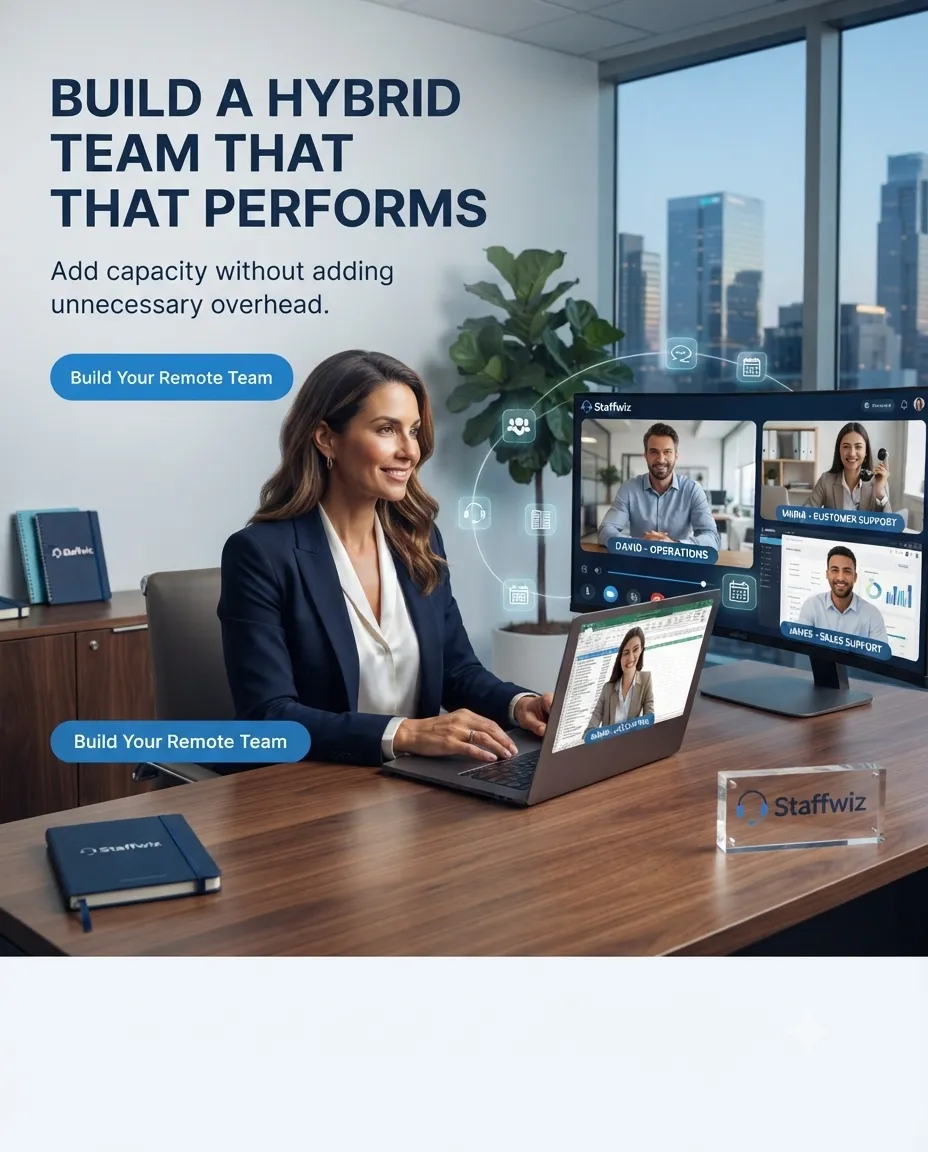
Hybrid Work Schedule: 5 Examples for Growing Teams | Staffwiz
Hybrid work is often described as a simple choice between working from home and working from the office.
For growing businesses, however, the more important question is not where people work.
It is:
How should your workforce be structured so the right work gets done by the right people without creating unnecessary cost, complexity, or bottlenecks?
A well-designed hybrid work schedule can give employees flexibility while maintaining accountability, collaboration, and access to the talent your business needs.
It can also allow companies to combine local employees with dedicated remote professionals, creating additional capacity without requiring every role to sit inside the same office.
Below are five common hybrid work schedule examples, how each works, and when each model makes sense.
What Is a Hybrid Work Schedule?
A hybrid work schedule combines remote and in-person work within the same organization.
Some companies establish specific office days. Others give employees more control over where they work. Growing businesses may take the model further by combining an in-house team with dedicated remote employees who handle functions that do not require a physical presence.
There is no single hybrid schedule that works for every company.
The right structure depends on:
The work being performed
Customer requirements
Team size
Collaboration needs
Management style
Employee responsibilities
Time zones
Technology
Business growth plans
The objective should be to design the workforce around business outcomes, rather than adopting hybrid work simply because other companies are doing it.
1. Fixed Hybrid Schedule
A fixed hybrid schedule establishes specific days when employees work in the office and specific days when they work remotely.
Example
Employees work:
Monday: Office
Tuesday: Remote
Wednesday: Office
Thursday: Office
Friday: Remote
Everyone knows where they are expected to work each day.
Best For
A fixed hybrid work model can work well for businesses that need:
Regular face-to-face collaboration
Predictable team meetings
Shared physical resources
Coordinated office attendance
Consistent scheduling
It provides flexibility without eliminating structure.
Potential Limitation
A fixed schedule can become unnecessarily rigid when different roles have very different requirements.
Your accountant, customer service representative, operations coordinator and sales manager may not all need the same office schedule.
That is where role-based workforce design becomes more effective.
2. Flexible Hybrid Schedule
Under a flexible hybrid schedule, employees determine when they need to work remotely and when they need to come into the office.
The company establishes expectations, but individual employees or teams have more control over their schedules.
Example
An employee may work remotely four days during a week but attend the office on Wednesday for:
Client meetings
Team planning
Training
Collaboration
The following week, their schedule could change.
Best For
Flexible hybrid work can be effective for companies that:
Manage employees based on outcomes
Have strong digital communication systems
Trust employees to manage their responsibilities
Have limited requirements for physical attendance
Potential Limitation
Flexibility without clear accountability can create confusion.
Businesses should define:
Expected availability
Response times
Meeting requirements
Ownership of tasks
Performance metrics
The goal should not be to monitor where employees are sitting.
The goal should be to know whether the required outcomes are being delivered.
3. Remote-First Hybrid Model
A remote-first company treats remote work as the standard operating model while maintaining office space for activities that benefit from face-to-face interaction.
Example
Employees normally work remotely but may use the office for:
Leadership meetings
Training
Strategic planning
Client meetings
Team events
Instead of designing every process around the office, processes are designed to work remotely first.
Best For
Remote-first structures can work particularly well for:
Consulting firms
Professional services companies
Digital businesses
Technology companies
Accounting teams
Marketing teams
Customer support organizations
Administrative operations
It can also significantly expand the geographic talent pool available to the business.
Your next great employee does not necessarily need to live within commuting distance of your office.
4. Role-Based Hybrid Schedule
A role-based hybrid model determines where someone works based on the requirements of their job.
This can be one of the most practical models for growing companies.
Instead of creating one policy for everyone, businesses ask:
Does this particular role genuinely require physical presence?
Example
A company could structure its team like this:
Primarily On-Site
Office manager
Facilities staff
Employees handling physical inventory
Hybrid
Sales leadership
Human resources
Project management
Client-facing managers
Remote
Bookkeeping
CRM administration
Scheduling
Customer support
Digital marketing
Sales support
Data entry
Research
Administrative support
This allows the business to design each role around how the work actually gets done.
Best For
Role-based hybrid staffing is particularly effective for businesses with a mixture of:
Customer-facing employees
Operational employees
Administrative employees
Specialist roles
Remote-capable support functions
It can also prevent companies from hiring expensive local employees for work that does not require local physical presence.
5. Blended Local and Remote Workforce
For growing businesses, there is another hybrid model worth considering.
Instead of thinking only about whether the same employee works remotely or in the office, a company can build a hybrid workforce consisting of local and dedicated remote employees.
Example
A growing business might keep:
Local Team
Founder
Sales director
Client relationship manager
Operations leader
While adding dedicated remote professionals for:
CRM management
Lead follow-up
Bookkeeping
Customer service
Administrative support
Scheduling
Digital marketing
Research
Project coordination
The local team remains focused on activities that genuinely benefit from being close to customers, leadership or physical operations.
The remote team handles work that can be performed effectively from anywhere.
Why This Model Is Different
This is not simply outsourcing random tasks.
When designed correctly, dedicated remote professionals become part of the company's operating structure.
They own clearly defined responsibilities and work alongside the existing team.
Staffwiz, for example, provides dedicated full-time remote professionals across more than 40 roles, including administration, customer service, marketing, finance, legal, healthcare, technology and real estate.
What Are the Benefits of a Hybrid Workforce?
The strongest benefits of hybrid work come from designing the workforce more intentionally.
1. Access to a Larger Talent Pool
Requiring every employee to live within commuting distance dramatically limits who you can hire.
Remote and hybrid staffing allows businesses to evaluate talent based on:
Skills
Experience
Communication ability
Industry knowledge
Software proficiency
Performance potential
rather than ZIP code alone.
2. Greater Business Capacity
Growing businesses frequently reach a point where the existing team cannot absorb additional work.
More clients create:
More emails
More scheduling
More customer service
More bookkeeping
More CRM updates
More reporting
More administration
More operational coordination
Eventually, the founder or senior employees begin absorbing those tasks.
That is not necessarily a demand problem.
It is often a capacity problem.
Adding the right remote professionals can increase capacity without forcing senior employees to spend more of their time on repeatable operational work.
3. Lower Workforce Costs
Not every position needs to carry the cost structure of a comparable domestic hire.
A company may be able to maintain its core local leadership while hiring qualified remote professionals for functions that can be performed remotely.
Staffwiz currently states that its fully managed remote staffing model can produce average payroll savings of up to 70% compared with traditional U.S. hiring, depending on the role and circumstances.
The important point is not simply to hire the cheapest person available.
The objective is to improve the relationship between:
workforce cost → capacity → productivity → business output
4. Better Use of Senior Employees
One of the clearest signs of a workforce design problem is highly paid employees spending substantial portions of their week performing lower-value administrative work.
Consider a sales director who spends hours:
Entering CRM notes
Updating reports
Scheduling appointments
Cleaning prospect lists
Sending routine follow-ups
Or a founder who spends evenings:
Chasing invoices
Checking spreadsheets
Answering routine customer emails
Reviewing administrative tasks
Those activities may be necessary.
They simply may not need to be performed by those particular people.
A properly structured hybrid workforce moves repeatable work to the appropriate role while allowing senior employees to focus on higher-value responsibilities.
5. More Scalable Operations
Businesses often discover operational weaknesses only after demand increases.
Ten additional customers may seem like good news.
But if those customers create:
Slower response times
More errors
Overtime
Missed follow-ups
Employee burnout
Founder involvement
then revenue may be growing faster than the infrastructure supporting it.
A scalable hybrid workforce allows companies to add capacity around the areas creating the bottleneck.
How to Choose the Right Hybrid Work Model
Before choosing a schedule, evaluate the actual work inside your company.
Step 1: List the Work
Document the recurring work being performed across the business.
Examples include:
Customer communication
Sales prospecting
Administrative work
Scheduling
Bookkeeping
CRM management
Reporting
Marketing
Research
Project coordination
Do not begin with employee names.
Begin with the work.
Step 2: Identify What Requires Physical Presence
Ask whether each responsibility genuinely needs somebody physically present.
Activities such as:
Handling inventory
Operating equipment
Meeting walk-in customers
may require on-site employees.
Activities such as:
Bookkeeping
Scheduling
CRM administration
Customer support
Research
Marketing execution
usually do not.
Step 3: Identify Your Bottlenecks
Look for work that is:
Consistently delayed
Being completed after hours
Falling back onto managers
Creating overtime
Preventing employees from focusing on their primary roles
These are strong candidates for additional staffing.
Step 4: Define Outcomes, Not Just Tasks
Weak job descriptions list activities.
Better roles establish ownership.
Instead of:
Update the CRM.
Define the outcome:
Maintain complete and accurate CRM records so every qualified lead has an owner, status and next action.
Instead of:
Answer customer emails.
Define:
Maintain agreed customer response times and ensure inquiries are resolved or escalated appropriately.
This becomes particularly important when managing distributed teams.
Step 5: Decide Whether You Need a Traditional or Hybrid Role
Businesses often assume every operational problem requires another conventional full-time job description.
It may not.
One carefully designed role could potentially combine related responsibilities.
For example:
Sales + CRM Coordinator
CRM updates
Lead research
Prospect follow-up
Appointment scheduling
Pipeline reporting
Administrative + Operations Coordinator
Scheduling
Documentation
Vendor coordination
Reporting
Administrative support
Customer Service + Sales Support
Customer inquiries
Follow-ups
CRM updates
Quote coordination
Appointment booking
The responsibilities should be compatible and realistic, but thoughtful role design can prevent businesses from creating multiple fragmented positions unnecessarily.
How to Manage a Hybrid Workforce Effectively
Regardless of which hybrid schedule you choose, management systems determine whether it succeeds.
Establish Clear Outcomes
Every employee should understand:
What they own
What success looks like
What deadlines apply
What metrics matter
Who receives escalations
Document Processes
Remote and hybrid employees perform better when workflows are documented.
Create repeatable processes for:
Customer service
Lead management
Reporting
Scheduling
Approvals
Escalations
Use Shared Systems
Your team should operate from common systems rather than private spreadsheets and disconnected conversations.
Depending on your business, that may include:
CRM
Project management software
Shared documentation
Communication platforms
Time tracking
Reporting dashboards
Measure Results
Hybrid management should focus heavily on output.
Useful metrics could include:
Response time
Tasks completed
Qualified appointments
Customer satisfaction
Data accuracy
Processing time
Accounts reconciled
Tickets resolved
Projects completed
The appropriate metric depends on the role.
Is Your Current Workforce Structure Holding Back Growth?
One of the most common scaling problems appears when a company has enough customers but not enough operational capacity.
You may notice:
Founders performing administrative work
Managers constantly checking routine tasks
Employees working overtime
Customer response times increasing
Sales leads waiting for follow-up
Back-office work accumulating
Additional revenue producing surprisingly little additional profit
Those are not simply productivity problems.
They can indicate that the business has outgrown its current team structure.
The answer may not be another expensive local hire.
It may be redesigning the work, identifying the roles creating the bottleneck, and determining which responsibilities can be handled by dedicated remote professionals.
Build a Hybrid Workforce Around Outcomes
Staffwiz helps growing businesses identify the remote roles they need and build dedicated teams around those requirements.
Staffwiz currently provides more than 40 remote roles across functions including:
Administration
Customer service
Sales support
Marketing
Finance and accounting
Legal
Healthcare
Technology
Real estate
With the fully managed model, Staffwiz handles sourcing, vetting, employment, payroll, HR, compliance and workforce support while your business manages priorities and day-to-day work.
Instead of asking:
“Who else can we hire?”
Start with:
“What work is preventing our current team from growing the business?”
That question usually leads to a much better workforce strategy.
Need Help Designing the Right Hybrid Role?
If you are unsure whether you need an administrative specialist, sales support professional, operations coordinator—or a role combining several related responsibilities—start with the work currently creating the bottleneck.
Book a free 15-minute workforce strategy call with Staffwiz to map the responsibilities, determine the right role structure and understand what a remote hire could realistically cost.
Build the team behind your growth.


